By: Nana
Appiah Acquaye
The European Union is
seeking to strengthen its space-based defence and security capabilities, with
European Commissioner for Defence and Space, Andrius Kubilius calling for
greater investment, improved intelligence infrastructure and closer
coordination between the EU, Member States, NATO and the private sector.
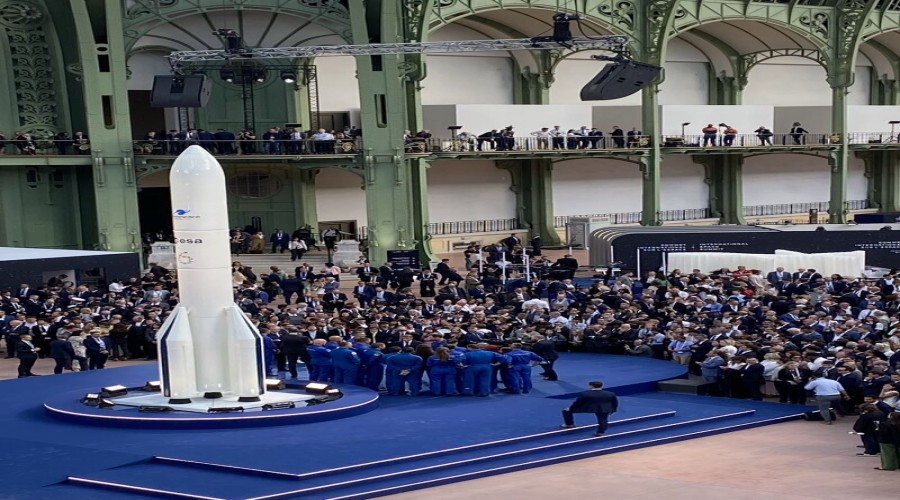
Speaking at the
International Space Summit in Paris, Kubilius said Europe’s space assets are
facing growing threats, including radio-frequency interference, jamming and
spoofing, suspicious proximity operations and the development of anti-satellite
weapons.
He said Russia’s war against
Ukraine has demonstrated the central role of space in modern warfare,
particularly for communications, Earth observation and intelligence.
“It’s impossible to defend
Europe without space,” Kubilius said, stressing that key European defence
priorities, including drone and missile defence, increasingly depend on
space-based capabilities.
The Commission plans to
strengthen EU Space Surveillance and Tracking to improve protection against
damage to satellites, whether deliberate or accidental, while also developing a
new system for in-space services and operations.
Kubilius also highlighted
the proposed European Space Act, which would establish common European rules
for space traffic and help reduce the risks of collisions and debris. A new
radio-frequency interference alert service is also planned.
The EU is expanding the use
of space-based communications for defence and security through Galileo,
GOVSATCOM and IRIS².
Galileo is expected to
provide strengthened encrypted communications through a new low Earth orbit
component, while GOVSATCOM allows Member States with secure satellite
communications capabilities to share them with countries that do not have
equivalent national systems.
IRIS², a planned
constellation of hundreds of satellites, is intended to provide secure
satellite connectivity for European governments and defence forces, enabling
secure communications and coordination through a common system.
Kubilius said the EU has
also begun negotiations to enable Ukraine to participate in GOVSATCOM and
IRIS², reflecting Europe’s efforts to strengthen its support for Ukraine’s
space-enabled security capabilities.
He warned, however, that
existing initiatives would not be sufficient to address Europe’s strategic
capability gaps, particularly as Russia’s aggression continues and the United
States places increasing strategic attention on the Indo-Pacific.
Space-based intelligence was
identified as one of Europe’s major gaps. Kubilius said national Earth
observation systems remain fragmented, and many are unable to provide the speed
and level of access required across the Union.
The Commission is therefore
planning an Earth observation service designed to provide all Member States
with high-speed, high-resolution geospatial intelligence on an almost real-time
basis and in all weather and lighting conditions.
Kubilius also announced
plans for the Commission to present a Communication on the European Space
Shield, describing it as a proposed European Space Security Architecture
designed with Member States to strengthen coordination and governance of space
security.
The initiative is expected
to examine how the European Union and national governments can work more
closely with NATO, civilian and military institutions, and public and
private-sector actors within a more integrated security framework.
Launch capability was
another priority highlighted by Kubilius, who congratulated German company ISAR
Aerospace on its recent progress and said European launch services would be a
major priority for the Commission’s space agenda.
He said Europe must also
significantly increase financing for space and defence. The European Commission
has proposed a five-fold increase in funding for defence and space in the next
multiannual EU budget.
Kubilius urged Member States
to support the proposal, arguing that Europe’s strategic autonomy increasingly
depends on its ability to develop and control critical space capabilities.
He said Europe’s ability to
secure its future in space would have a direct impact on its security,
competitiveness and resilience on Earth.