By: Nana
Appiah Acquaye
Egypt’s Minister of
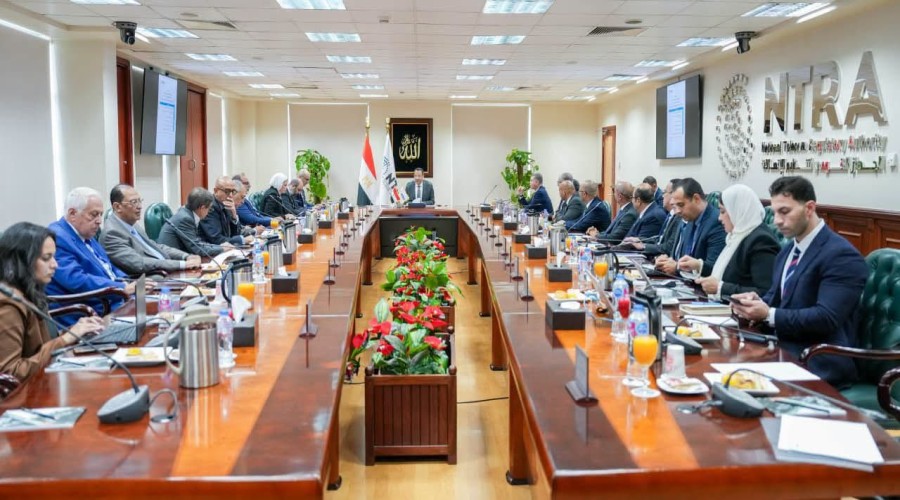
Communications and Information Technology Raafat Hendy has met with members of
the Telecom Industry Committee of the National Telecom Regulatory Authority
(NTRA) to discuss strategic priorities, opportunities and challenges facing the
country’s telecommunications industry.
The meeting followed the
recent reconstitution of the committee, which brings together leaders and
experts from across Egypt’s ICT sector, and focused on strengthening the
domestic telecom industry’s productive capacity and competitiveness in line
with the Digital Egypt strategy.
Hendy said Egypt’s ICT
sector had undergone rapid transformation in recent years and had become a key
driver of economic growth, extending beyond technology services to areas
including digital infrastructure, data centers, cloud computing, artificial intelligence
(AI), local manufacturing, digital identity and online safety.
He noted that the sector
recorded a growth rate of 19.3% in fiscal year 2025/2026, making it one of the
country’s fastest-growing sectors.
The Minister highlighted the
launch of Egypt Mobile Spectrum Roadmap 2026–2030 and the expansion of 5G
networks as key developments supporting high-speed, high-performance
telecommunications networks, while creating opportunities for Internet of
Things (IoT) applications and smart cities.
He also said work was under
way to develop the national strategy for data centers.
Hendy said AI tools would
play a pivotal role in economic growth and transformation by boosting
productivity, enabling new business models and creating opportunities for
Egyptian startups, investors and developers to expand into local, regional and
international markets.
He added that AI was
increasingly a core element of digital sovereignty, while data centers, cloud
computing and AI infrastructure were becoming key pillars of national digital
capabilities to support the economy, protect data and enhance the security and
independence of digital decision-making.
On digital services, Hendy
said the Digital Egypt platform had reached nearly 250 services in September,
with plans to increase the number to 270 by the end of the year and 400 by
2030.
He also said the digital
identity system had been launched to support Egypt’s digital transformation.
Digital exports have also
expanded, with Hendy stating that they surged 124% since 2018 to reach $7.4
billion in 2025.
He said more than 10 million
mobile phones were produced domestically in 2025, compared with about 3.3
million in 2024, as Egypt attracted major mobile phone manufacturers.
Hendy said the mobile phone
governance framework was primarily designed to safeguard and support domestic
manufacturing while strengthening its competitiveness. He added that efforts
were continuing to expand local production of mobile phone accessories,
fiber-optic cables, electronic components and semiconductors.
The Minister also outlined
government efforts to strengthen digital safety, including the launch of the
Wa3i.net platform and awareness messages issued by NTRA to protect adolescents
from online risks. He cited the Etmaen (Rest Assured) and Etmaen Ala El Akher
(Rest Fully Assured) services, launched last July, and said MCIT was
contributing to the drafting of a digital safety law.
Hendy said the reconstituted
Telecom Industry Committee would serve as a platform for improving coordination
among ICT sector stakeholders and building consensus around priorities for
developing the local industry.
He identified continued
efforts to deepen local manufacturing, strengthen private-sector partnerships,
promote innovation, develop digital skills and talent, upgrade infrastructure,
expand export opportunities, attract investment and ensure a secure and trusted
digital environment as key to increasing the sector’s contribution to
investment, production, exports and job creation.
For his part, Executive
President of NTRA Mohamed Shamroukh outlined three areas representing NTRA’s
current priorities for developing the telecom industry: data centers, local
manufacturing and digital identity.
On data centers, Shamroukh
reviewed opportunities and challenges in Egypt’s market and said the national
strategy focuses on AI and cloud computing.
The meeting also examined
challenges and opportunities surrounding domestic mobile phone production,
including efforts to increase local components, deepen manufacturing, expand
exports and scale up production of electronic devices beyond mobile phones.
On digital identity, the
meeting noted that the biometric verification system was developed jointly by
the Ministry of Interior, the Information Technology Industry Development
Agency (ITIDA), and NTRA.
The system is currently
being piloted with the four mobile network operators (MNOs), supporting
services including SIM card purchases, e-wallet opening and user identity
verification. It has also been used for Digital Egypt services.
The system is designed as
scalable digital infrastructure that can be expanded to support a broader range
of government, financial and economic services as Egypt advances towards an
integrated digital society.
At the end of the meeting,
the Telecom Industry Committee put forward recommendations focused on opening
new avenues for growth in the telecom industry, addressing challenges facing
local manufacturing, exploring opportunities to expand data center and cloud
computing capabilities, promoting the local manufacturing of telecom equipment
and establishing effective mechanisms to support and promote locally
manufactured products.