By: Nana
Appiah Acquaye
Cameroon has been selected
to host the headquarters of the Assembly of Telecommunications Regulators of
Central Africa (ARTAC), following a decision by telecommunications regulators
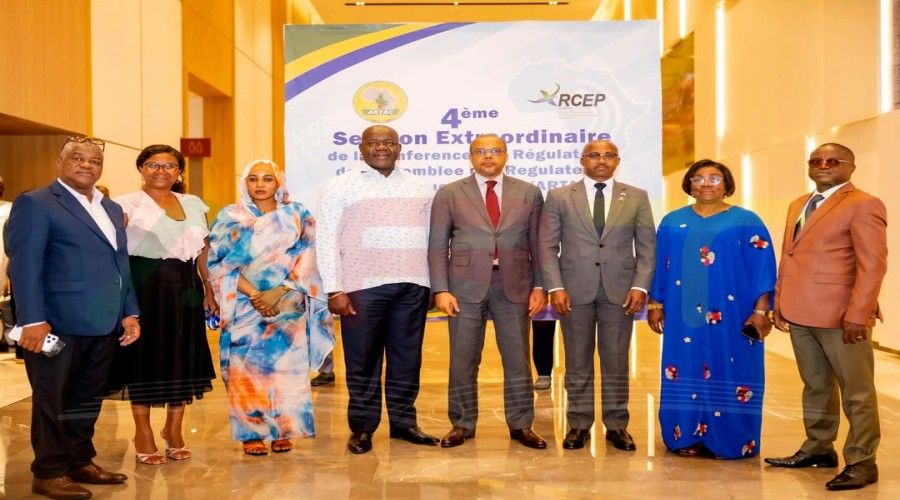
at the organisation’s 4th Extraordinary Session in Libreville, Gabon, on
October 20 and 21, 2026.
The decision was among the
key resolutions adopted at the meeting, which brought together representatives
of telecommunications regulatory authorities from Cameroon, the Central African
Republic, Congo, the Democratic Republic of the Congo, Gabon, Chad and São Tomé
and Príncipe to discuss the organisation’s institutional and operational
future.
The regulators also
entrusted Cameroon’s Telecommunications Regulatory Board (TRB) with the
responsibility of appointing ARTAC’s Executive Secretary, in accordance with
the rotation mechanism provided for in the organisation’s governing texts.
Led by TRB Director General
Professor Philémon Zoo Zame, the Cameroonian delegation participated in
proceedings that resulted in the adoption of revised foundational instruments,
including ARTAC’s Statutes, Rules of Procedure and Financial Regulations. The
session also marked the official launch of thematic working groups expected to
shape the organisation’s future activities.
The decision to establish
ARTAC’s headquarters in Cameroon reflects the confidence of sub-regional
regulators in the country’s ability to advance shared objectives in digital
governance, regulatory harmonisation and telecommunications development.
Since ARTAC’s creation, the
functions of Permanent Secretary have consistently been held by Cameroonian
officials, reflecting the TRB’s longstanding commitment to digital cooperation
and regional integration in its capacity as a “guarantor regulator.”
Created following a decision
of the Central African Conference of Posts and Telecommunications (COPTAC) to
strengthen cooperation among national regulatory authorities, ARTAC provides a
platform for experience-sharing, consultation and the development of common
positions on electronic communications and the digital economy.
The organisation’s
priorities include regional free roaming, radiofrequency spectrum management in
border areas, and stronger representation of Central Africa within
international regulatory bodies.
Regional free roaming
remains one of ARTAC’s flagship cooperation projects, with the objective of
enabling citizens to communicate across borders at lower costs while promoting
mobility and economic exchanges.
During the Libreville
meeting, Professor Zoo Zame also met Cameroon’s Ambassador to Gabon, H.E. Edith
Félicie Noëlle Ngaeto Zam, to discuss progress in implementing roaming
arrangements between the two countries.
The regulators also adopted
a resolution on the organisation and operation of the Central African ICT
Observatory, which is expected to serve as a reference tool for collecting,
analysing and sharing telecommunications sector data across the sub-region.
In another decision, the
conference approved the accession of the regulator of São Tomé and Príncipe,
expanding ARTAC’s geographical scope and strengthening its regional
representation.
The institutional reforms
adopted in Libreville are expected to provide the organisation with more modern
tools and a consolidated governance framework as Central African countries seek
coordinated responses to challenges involving connectivity, innovation and
digital sovereignty.