By: Nana
Appiah Acquaye
The European Space Agency
(ESA) has called for urgent collective action to strengthen Europe’s strategic
autonomy, security and resilience, warning that the continent must close the
gap between its technological capabilities and its ability to translate them
into strategic advantage.
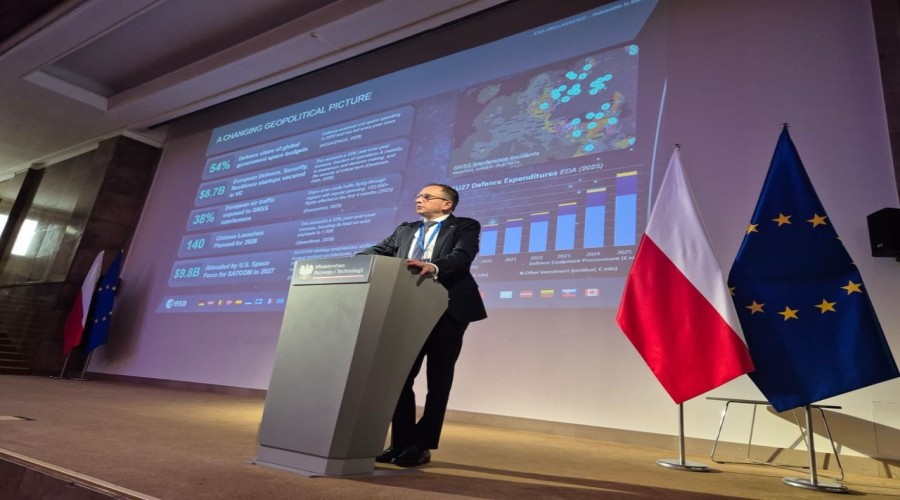
Laurent Jaffart, ESA
Director of Resilience, Navigation and Connectivity and Head of the European
Centre for Space Applications and Telecommunications (ECSAT), made the call
during his address at the European Economic Forum in Lucerne, Switzerland,
where he examined what Europe is getting wrong and who must take responsibility
for addressing the challenges.
Jaffart identified four
major challenges facing Europe: speed, fragmentation, dependency and scale,
arguing that overcoming them would require stronger cooperation, coordinated
investment and greater commitment from governments, industry and investors.
"Europe has world-class
technological, scientific, and industrial capabilities. Through ESA, our Member
States have demonstrated what European cooperation can achieve. But we must go
further, closing the gap between our technological strengths and our ability to
turn them into strategic advantage," he said.
He emphasised ESA's role in
developing critical technologies, delivering strategic programmes and bringing
Member States and industry together to strengthen Europe's space capabilities.
According to Jaffart,
delivering this ambition will require commitment at every level, including ESA
Member States, the European Union, industry and investors.
"We must turn
cooperation into coordinated investment, innovation into industrial strength,
and programmes into operational prowess," he said.
He added that ESA's
responsibility was to enable Europe with the space capabilities needed to
safeguard its interests while strengthening and shaping its future.
Jaffart stressed that
strategic autonomy, security and resilience must move beyond political
aspirations and become integral to the technologies Europe develops and
deploys.
"The task ahead demands
leadership, urgency, and the willingness to act collectively. The time for
delivery is now," he said.