By: Nana Appiah Acquaye
Kenya has emphasised the need for deliberate policy action to address global digital inequality,
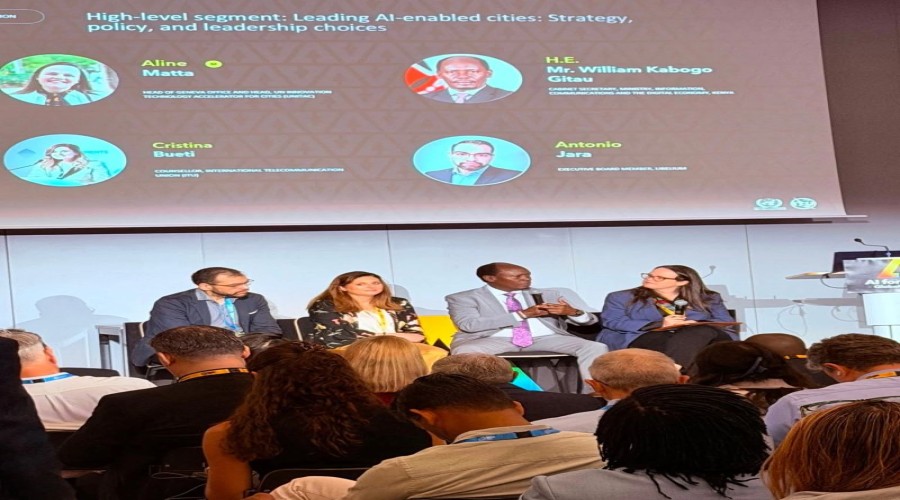
with Cabinet Secretary for Information, Communications and The Digital Economy,
Hon. William Kabogo Gitau, stressing that artificial intelligence (AI) alone
will not close the connectivity gap facing millions of people worldwide.
Speaking
at the WSIS Ministerial Roundtable on AI, Digital Transformation and Inclusion
in Geneva, Kabogo said that while AI presents significant opportunities,
achieving inclusive digital transformation requires strong policy frameworks,
investment in digital infrastructure and efforts to build local capacity.
The
Cabinet Secretary noted that about one-third of humanity remains offline,
emphasizing that governments must take intentional steps to ensure that
emerging technologies benefit all communities rather than widening existing
inequalities.
During
the roundtable, Kabogo shared Kenya’s digital transformation experience,
highlighting the country’s eCitizen platform, which provides access to more
than 22,000 government services and serves over 13 million Kenyans.
He
also outlined Kenya’s National Artificial Intelligence Strategy, which places
people at the centre of AI development, as well as the country’s Data
Protection Act enacted in 2019 to strengthen trust and responsible data
management.
However,
the Minister acknowledged that significant challenges remain, particularly for
countries in the Global South, where access to advanced digital skills,
computing infrastructure and quality data continues to limit AI adoption.
Kabogo
reaffirmed Kenya’s commitment to implementing the resolutions of the World
Summit on the Information Society (WSIS) through a national digital roadmap,
with progress reporting expected to begin in 2027.
The
ministerial dialogue brought together government leaders and digital
policymakers to discuss approaches for advancing inclusive digital
transformation, responsible AI governance and equitable access to emerging
technologies.