By: Nana
Appiah Acquaye
The Government of Ghana has
reaffirmed its commitment to developing the next generation of digital talent
by exposing young people to artificial intelligence, robotics, coding and other
emerging technologies at an early age.
The commitment was expressed
by the Minister for Communication, Digital Technology and Innovations, Hon.
Samuel Nartey George, in a statement delivered on his behalf by the Director
for Innovations at the opening of a five-day AI and Robotics Summer Bootcamp.
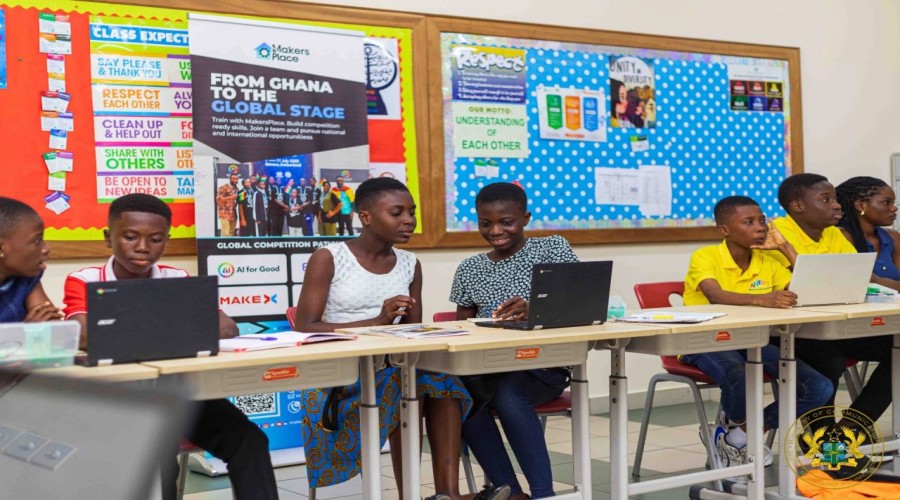
The programme brings
together 100 students from 19 schools and is designed to provide participants
with practical experience in artificial intelligence, robotics, coding and
other technologies expected to shape the future of work and economic activity.
The participating schools
include Nima Cluster of Schools, Teshie Anglican Basic School, 37 Military
Basic School, Accra Newtown Experimental School, Osu Ringway Estate Basic
School, Salem School, Osu, Mizpah International School, KinderKids International
School, Royal Standard Learning Centre, My Redeemer School, Globen School,
Labone S.D.A. Church School, University of Ghana Basic School, Sunflower
School, AgyeBaff Educational Center, Ahtoo Montessori School, Crystal Gate
International School, Platinum School and Ghana International School.
Participants have been
grouped according to age and grade level to ensure that the training is
appropriate to their developmental and educational needs.
The Foundation cohort
comprises learners aged 6 to 8 in Grades 1 to 3, while the Junior cohort covers
those aged 9 to 11 in Grades 4 to 6. The Intermediate cohort includes learners
aged 12 to 14 in Grades 7 to 9, with the Senior cohort covering students aged
15 to 18 in Grades 10 to 12.
According to the Minister,
the age-based structure enables trainers to tailor learning activities to the
abilities of each group, ranging from structured guidance and visual or
block-based tasks for younger learners to robotics and coding challenges, independent
programming, design and advanced problem-solving for older students.
George said the Bootcamp is
based on a hands-on learning model that encourages students to experiment with
emerging technologies and apply their knowledge to practical challenges.
Through guided activities,
experimentation and project development, participants are expected to test
ideas, develop solutions and gain early experience in using technology to
address real-life problems.